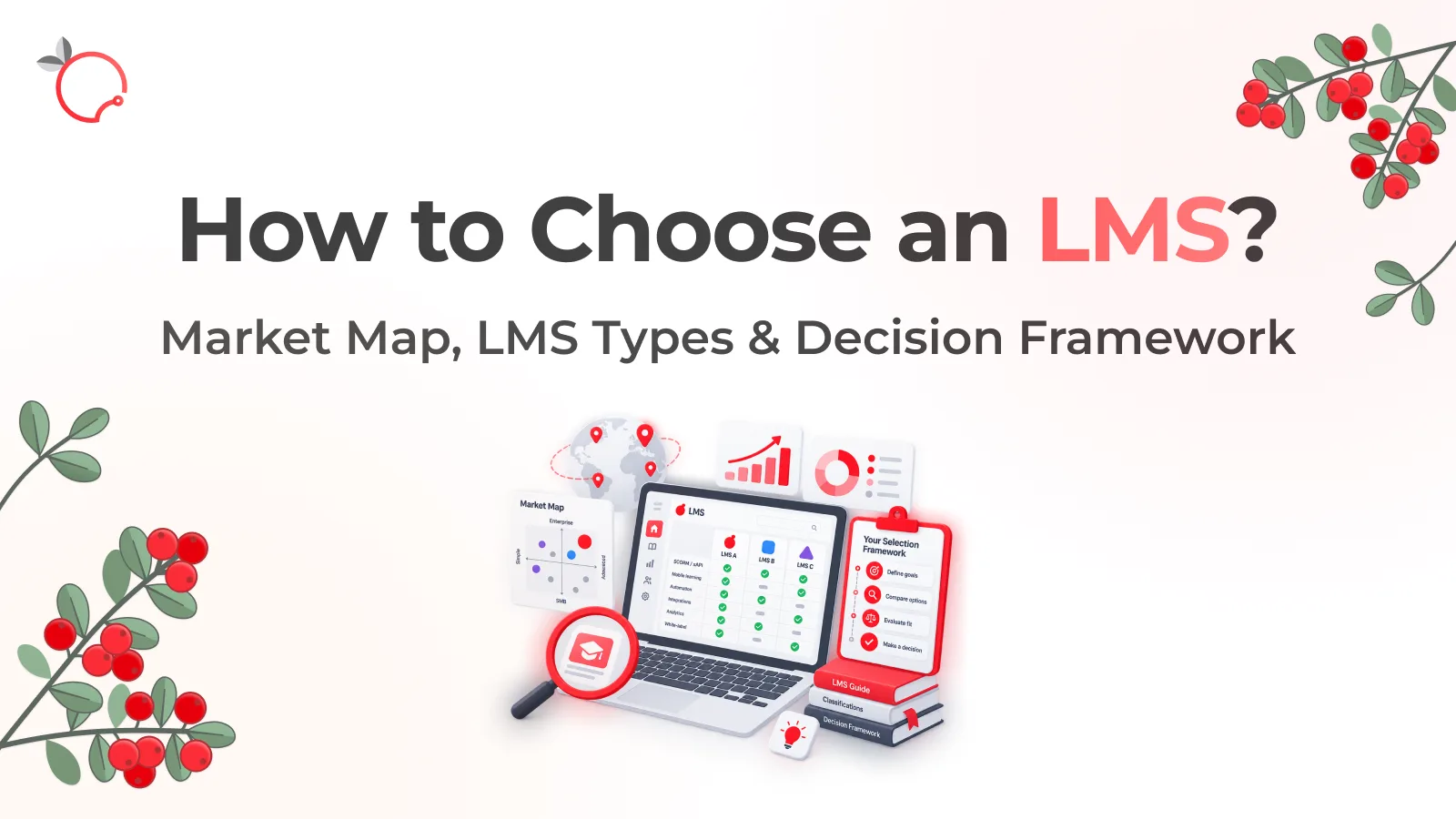
LMS Selection Guide: Market Map, Classifications, and Practical Decision Framework

1. The Choice Paradox: Why There Is No "Best" LMS
Choosing a Learning Management System (LMS) often begins with a fundamental error: searching for the "best" platform. In enterprise architecture, this is as illogical as asking whether a sports car, a heavy mining dump truck, or an electric scooter is the "best" vehicle. A high-performance sports car is a systemic failure if your strategic goal is to move fifty tons of ore, just as a dump truck is a liability for a rapid urban commute.
The primary cause of EdTech project failure is architectural misalignment. Forcing a system designed for commercial online schools into a complex corporate environment results in significant "technical debt," manifested through exhausting manual data entry and the emergence of "shadow" L&D processes as managers bypass rigid, ill-fitting software. Strategic success depends entirely on selecting an LMS that natively aligns with your organizational "environment."
2. The Essence of an LMS: An Interaction Model, Not a Content Warehouse
For a business, an LMS is not a video-lesson repository — it is the digital core of the interaction between an organization and its learners. The strategic choice of a system must be grounded in the relationship model it is built to support. Depending on the business goal, the role of the LMS transforms radically:
- A Knowledge Store (EdTech): The system functions as a hybrid of a storefront, a payment gateway, and a marketing funnel.
- A Human Capital Management Tool (HR): An element of the corporate ecosystem, tightly synchronized with the org structure, job roles, and KPIs.
- A Knowledge Ledger (Academic Sector): Focused on the strict accounting of academic hours, grading-point systems, and compliance with government standards.
3. The Causality Chain: From Business Model to Feature Set
LMS selection must be a top-down strategic decision rather than a bottom-up feature-comparison exercise. To ensure architectural fit, leadership must map the organization's logic through a rigorous Causality Chain:
Type of Organization → Learning Model → Technical Requirements → Essential Integrations
Each link in this chain dictates the technical specifications. If the business model shifts, the architectural requirements change fundamentally because the underlying Key Performance Indicators (KPIs) serve different masters:
- Corporate Sector KPIs: Focused on Time-to-Productivity, employee retention, and competency coverage.
- EdTech Sector KPIs: Focused on Revenue, Customer Acquisition Cost (CAC), and Lifetime Value (LTV).
- Academic Sector KPIs: Focused on Regulatory Compliance, GPA scales, and semester completion rates.
Understanding this chain is the prerequisite for exploring the seven primary classes of the market, which should be viewed not merely as categories, but as architectural archetypes.
4. The Global Market Map: 7 Essential LMS Classes
These classes are defined by their "architectural core" — the fundamental logic upon which the database, user permissions, and experience are constructed.
4.1. Corporate LMS (L&D Focus)
This archetype focuses on human capital management. It is designed to be an organic extension of the HR ecosystem rather than a standalone silo. Modern corporate systems are shifting toward "Learning in the Flow of Work," a concept pioneered by Josh Bersin, where learning is not a destination but a frictionless intervention at the point of need.
Core Features: Automated onboarding, Individual Development Plans (IDPs), 360-degree feedback, and dynamic enrollment based on organizational hierarchy.
Essential Integrations: Global ERP and HRM systems like SAP SuccessFactors, Workday, and BambooHR.
The "So What?": By mirroring the org chart, the LMS ensures that as soon as a person is promoted in the HRM, the system immediately triggers the appropriate leadership training, eliminating administrative friction and accelerating productivity.
4.2. EdTech LMS (Commercial Online Schools)
An EdTech LMS is a marketing and sales engine with a delivery layer attached. Its architecture is built to convert and retain.
Core Features: Marketing funnels, payment gateways (Stripe, PayPal), drip content (stop-lessons), and churn analytics.
The "So What?": The primary goal is the transaction. If the system cannot handle a promo code or a tiered subscription model, the business model collapses regardless of the content quality.
4.3. Academic LMS (Higher Education)
The "dump truck" of the sector. These systems are built to handle the massive, complex logistics of universities and degree-granting institutions.
Core Features: Semester-based scheduling, GPA scales, complex grading rubrics, and LTI standards.
Essential Integrations: Plagiarism checkers (Turnitin) and remote proctoring tools.
The "So What?": Academic systems prioritize "academic honesty" and regulatory record-keeping. The high administrative overhead is a feature, not a bug, ensuring the integrity of the degree.
4.4. K-12 LMS (Primary/Secondary Education)
Specifically tailored for younger learners and a unique stakeholder triangle: teacher, student, and parent.
Core Features: Simplified, gamified UI/UX, "Parent Portals," and electronic grade books.
The "So What?": Success is measured by parent engagement; if a parent cannot instantly verify a child's homework compliance, the system fails its primary administrative purpose.
4.5. Commercial Training Centers (Vocational/B2B)
A hybrid class combining the commercial engine of EdTech with the administrative rigor of corporate compliance.
Core Features: Scheduling for physical/digital hybrid classrooms, B2B contract billing, and mandatory government reporting.
Essential Integrations: National certification registries and B2B CRM systems.
The "So What?": These centers must prove to corporate clients that employees were legally certified, requiring high-audit-trail reliability to protect both the center and the client from liability.
4.6. Customer Education LMS
The "electric scooter" of the market — light, fast, and designed for maximum adoption with minimum friction.
Core Features: Public self-registration, interactive product tours, and minimizing Time-to-Value (TTV).
Essential Integrations: Product analytics (Mixpanel, Amplitude) and helpdesks (Zendesk).
The "So What?": This is a churn-reduction tool. The faster a customer becomes an expert in the product, the less likely they are to cancel their subscription.
4.7. Extended Enterprise & Partner LMS
Designed for brands that must train people who do not work for them, such as dealer networks or franchisees.
Core Features: Multi-tenancy (strict data isolation between different partners) and delegated administration.
The "So What?": This is a Risk Management tool. It ensures Brand Consistency across a global network. By delegating user management to the franchisee, the parent brand maintains standards without the impossible task of managing 10,000 external accounts.
5. Secondary Axes: Architecture and Strategic Portability
Beyond the primary class, technical infrastructure defines the long-term scalability and security of the learning environment.
SaaS vs. On-Premise: SaaS offers speed and lower TCO, but On-Premise remains the requirement for high-security sectors needing total data sovereignty and strict privacy compliance.
Standalone vs. Embedded: The industry is moving toward Embedded systems. Rather than requiring users to visit a "Learning Portal," the LMS lives inside the tools they already use (CRM, ERP, or Teams), providing frictionless intervention at the moment a task is being performed.
Data Standards: The Strategy of Future-Proofing:
SCORM: For legacy content portability. Relying solely on SCORM is a strategic risk as it limits data to "Pass/Fail" metrics.
xAPI & cmi5: The standard for Advanced Behavioral Analytics. These allow for tracking learning outside the LMS (e.g., in a flight simulator or CRM), providing the data needed for true ROI calculations.
LTI: Critical for interoperability, allowing the LMS to act as a "plug-and-play" hub for external educational tools.
6. The Comparative Matrix: Executive Summary
| LMS Class | Primary Audience | Core Task | Key Integrations | Revenue Model |
|---|---|---|---|---|
| Corporate | Internal Employees | Talent Dev / Productivity | HRM (SAP, Workday), ERP | Value Protection / Productivity |
| EdTech | B2C Students | Selling Knowledge | Payment Gateways, CRM | Direct Sales / Subscriptions |
| Academic | Students / Faculty | Degree Programs | Plagiarism, Student Info | Tuition / Risk Mitigation |
| K-12 | Kids / Parents | School Curriculum | Regional Ed-Systems | Government / Risk Mitigation |
| Training Center | B2B / B2C Groups | Vocational Certs | B2B CRM, Gov Registries | Contract Billing / Revenue |
| Customer Ed | Product Users | Product Adoption | Support Desk, Analytics | Churn Mitigation / LTV |
| Extended Ent. | Dealers / Partners | Brand Standards | Partner Portals, PRM | Brand Consistency / Quality |
7. The Selection Algorithm: A Practical Decision Framework
To minimize technical debt, apply this diagnostic logic to your organization:
- Who is the learner? (Staff = Corporate; Buyer = EdTech; Partner = Extended Enterprise).
- Is there a commercial transaction? (If yes, you need the "Shop" architecture of EdTech or Training Centers).
- Does the system need to mirror an organizational hierarchy? (If you need to report by "Region > Branch > Manager," a Corporate LMS is non-negotiable).
- Does the learning happen inside another tool? (If users live in a CRM or Teams, an Embedded solution is required to ensure productivity).
Decision Tree Logic:
IF you have high-turnover frontline staff and need rapid, frictionless onboarding, THEN look for the "Electric Scooter" agility of a Customer Ed LMS or an Embedded Corporate solution.
IF you are training a partner network and require data isolation between competitors, THEN you must prioritize Extended Enterprise with Multi-tenancy.
IF you are a university focused on research and strict grading standards, THEN look for an Academic LMS with LTI and Proctoring support.
8. Conclusion: Environmental Alignment
The "best" LMS is the one that natively fits your organizational environment. Strategic alignment ensures that software supports your business processes rather than forcing your team to adapt their workflow to the limitations of the software.
For organizations seeking a Corporate LMS designed for deep integration into modern working contexts, Brusnika.LMS represents the "Embedded" archetype. By living within environments like Bitrix24 or Kommo, it enables learning to happen as a frictionless intervention in the flow of work, directly driving productivity without context-switching. Before requesting vendor demos, stakeholders must first map their internal business processes and identify which of the seven architectural archetypes matches their mission. Only then can a technology choice lead to a measurable strategic return.