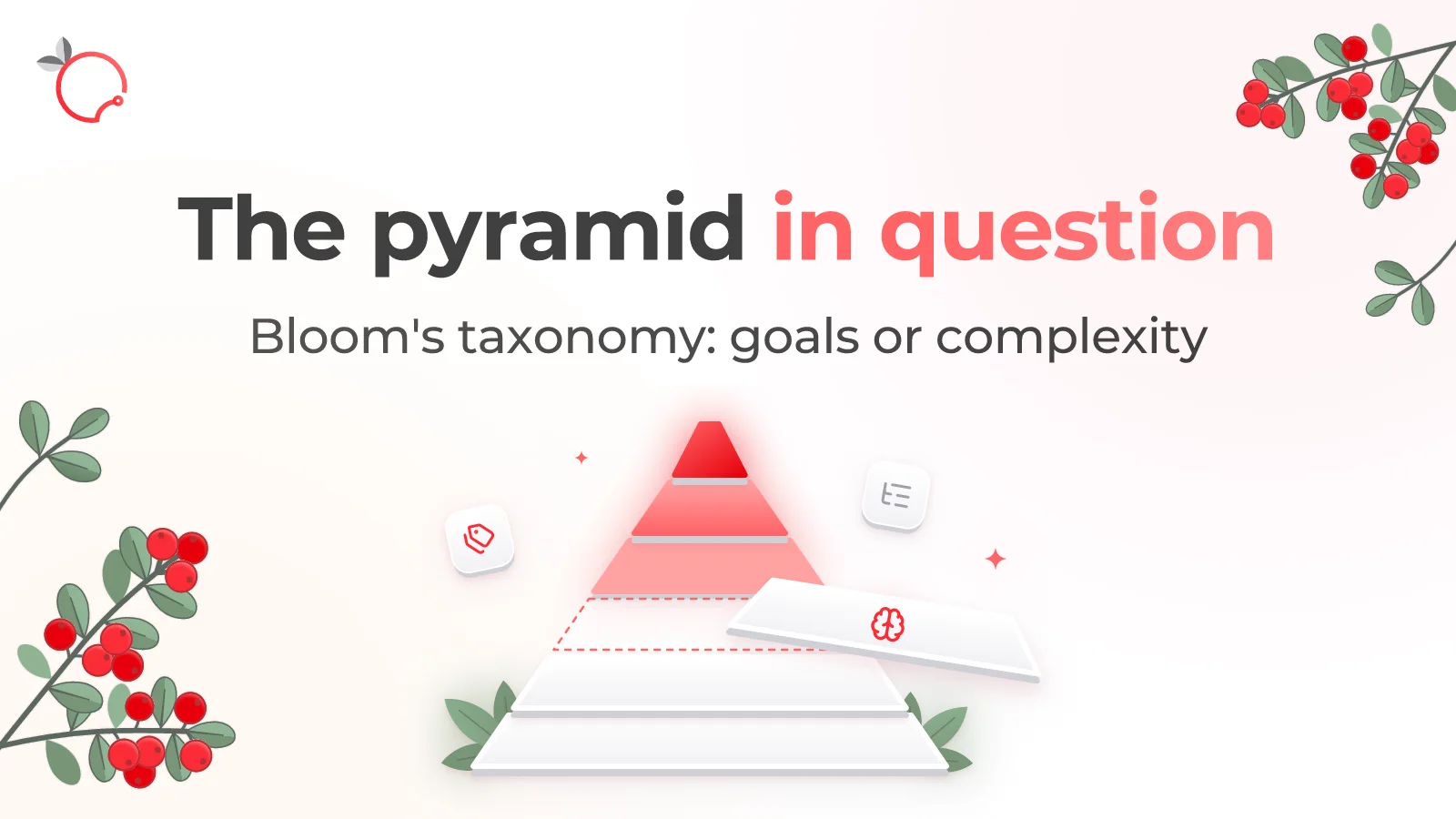
Bloom's Taxonomy: Between the Classification of Educational Goals and the Real Complexity of Cognitive Activity

Abstract
Benjamin Bloom's taxonomy of educational objectives remains one of the most widely used tools of instructional design. It is used to formulate learning outcomes, classify learning tasks, develop assessment materials, and determine the presumed level of cognitive complexity. However, there is a fundamental difference between the original purpose of the taxonomy and the way it is applied today: a tool for classifying educational goals is often perceived as a universal model of thinking and even as a scale for measuring the complexity of cognitive activity.
This article examines the historical foundations of the taxonomy, the logic of its 2001 revision, empirical studies of its hierarchical structure, the validity of using verbs as indicators of cognitive processes, the influence of subject content and context, and the limitations of the taxonomy in assessing results and predicting the transfer of learning to professional practice.
It is shown that the taxonomy retains its value as a common language for describing educational goals and as a means of aligning learning tasks. At the same time, the available research does not provide sufficient grounds for regarding it as a universal measurement model of cognitive complexity. The categories of the taxonomy should not be equated with the objective difficulty of a task, cognitive load, or the quality of a demonstrated result.
The final part proposes a practical five-facet scheme for describing a learning outcome that combines content, cognitive action, context, quality of the result, and transfer to practice. It is considered not a new validated theory but a methodological framework that helps learning designers avoid reducing a complex learning outcome to a single classification label.
Keywords: Bloom's taxonomy, educational goals, cognitive processes, cognitive complexity, assessment, validity, transfer of learning, corporate training, instructional design.
1. Introduction: Why the Popularity of the Taxonomy Does Not Yet Prove Its Universality
Bloom's taxonomy occupies a special place in modern educational practice. Its categories — "know," "understand," "apply," "analyze," "evaluate," and "create" — have become the familiar language of teachers, methodologists, instructors, and corporate learning specialists. Learning goals are written, tests are designed, programs are developed, and requirements for learning outcomes are formulated on the basis of the taxonomy.
An approach in which each category is matched with a particular set of verbs is especially widespread. For example, "define" is assigned to knowledge, "explain" to understanding, "apply" to application, "compare" to analysis, "assess" to evaluation, and "design" to creation. It is assumed that choosing the right verb makes it possible to set the required level of thinking and to make a learning goal measurable.
At first glance, this is an extremely convenient construction. It offers a simple sequence from relatively simple mental actions to more complex ones and helps structure learning programs. But it is precisely the simplicity of application that creates the risk of excessively expanding its meaning.
In practical work, the taxonomy is often used in three different roles at once:
- Classification of educational goals — a way to describe what result is intended to be achieved.
- Model of cognitive activity — a representation of which mental processes a person performs.
- Tool for design and assessment — a way to determine the complexity of tasks, build assessment materials, and judge the quality of learning.
These functions are related but not identical. The fact that a classification helps describe an educational goal does not mean that it measures the real complexity of thinking. The fact that a learning task has been assigned to the category "analysis" does not mean that the learner is actually performing an analytical operation in exactly the sense the classification assumes. And even less can one automatically infer from this label how well the learner will cope with a similar task at work.
The central question of this study is formulated as follows:
To answer it, we need to consider not only the structure of the taxonomy itself but also the validity of the transitions from an educational goal to a cognitive process, from a cognitive process to the complexity of a task, and then from the successful completion of a learning task to a professional result.
The main thesis of the article is as follows: Bloom's taxonomy retains practical value as a descriptive language of educational goals, but its capabilities as a measurement model of cognitive complexity and as a predictor of learning effectiveness are significantly limited. The problem is not that the categories of the taxonomy are useless but that they are often credited with functions for which there is insufficient theoretical and empirical basis.
2. What the Authors of the Taxonomy Were Actually Creating
To assess how the model is applied today, it is important to return to its original purpose.
Work on the taxonomy began in the late 1940s within the professional community of American specialists in educational measurement. One of the practical problems was the lack of a common language that would allow instructors and examiners to compare educational goals and assessment tasks.
Educators could use different wording to describe similar outcomes, and examinations created at different institutions turned out to be difficult to compare. The authors sought to develop a classification that would help formulate goals more precisely, discuss the content of instruction, and systematize ways of verifying results.
In 1956, the first volume of Taxonomy of Educational Objectives: The Classification of Educational Goals, devoted to the cognitive domain, was published (Bloom et al., 1956).
It identified six main categories:
- Knowledge. Recalling facts, terms, principles, regularities, and theories.
- Comprehension. Interpreting, translating information from one form to another, explaining, and extrapolating.
- Application. Using abstractions and learned principles in specific situations.
- Analysis. Breaking material into elements, identifying the relationships between them, and understanding the principles of organization.
- Synthesis. Combining elements into a new structure, creating a plan, a message, or a solution.
- Evaluation. Judging the value of material or a method on the basis of internal and external criteria.
The categories were arranged in a particular sequence reflecting the presumed increase in the complexity of educational goals.
However, here it is important not to make a common historical mistake. The authors did not create a psychometric scale that would make it possible to measure the complexity of an individual's thinking. The taxonomy was, above all, a classification scheme intended for organizing and discussing educational goals.
Moreover, the original work did not present the hierarchy as a definitively proven regularity of human thinking. It relied on the assumption of a sequential increase in the complexity of the categories, but the classification itself was not the result of building and empirically validating a universal scale of cognitive processes.
This distinction is fundamental. A classification answers the question: "What type of educational goal does this result belong to?" A measurement model must answer a different question: "How pronounced is a given property, and how can it be measured reliably?"
The original taxonomy was developed to solve the first task. Modern practice often expects it to solve both.
3. The 2001 Revision: What Changed and What Remained
In 2001, Lorin Anderson and David Krathwohl proposed a revised version of the taxonomy (Anderson & Krathwohl, 2001). David Krathwohl, one of the members of the original group, separately set out the logic of the changes in a 2002 article.
The revision was not simply a replacement of nouns with verbs. It changed the structure of how educational goals are represented and added a second dimension.
3.1. From Categories to Cognitive Processes
Instead of the original category names, verb-based labels came into use:
| Original version | Revised version |
|---|---|
| Knowledge | Remember |
| Comprehension | Understand |
| Application | Apply |
| Analysis | Analyze |
| Synthesis | Evaluate |
| Evaluation | Create |
The order of the last two categories changed: creating came to stand above evaluating.
Each category was further divided into subcategories. For example, the process of understanding included interpreting, classifying, summarizing, inferring, comparing, and explaining.
3.2. The Second Dimension: Type of Knowledge
In the revised model, an educational goal is described not only through a cognitive process but also through a type of knowledge:
- factual;
- conceptual;
- procedural;
- metacognitive.
As a result, a so-called taxonomy table emerged, in which cognitive processes are matched with types of knowledge.
This was an important conceptual improvement. It made it possible to describe goals more precisely, since the same cognitive action can relate to different types of content.
For example, applying factual knowledge and applying a complex professional procedure are not the same thing, although both results can be labeled with the category Apply.
3.3. Has the Problem of Measuring Complexity Been Solved?
The revision made the model more flexible and more convenient for describing educational goals. But it did not remove the main question: how justified is it to regard the categories as successive steps of cognitive complexity?
Moreover, in the new model the knowledge dimension and the cognitive process dimension are presented as two independent dimensions. This is convenient for classification but assumes that they can be distinguished reasonably clearly.
It was precisely these assumptions that later became the subject of empirical testing.
Consequently, the 2001 revision should be regarded as a development of a classification tool and not as the creation of an empirically confirmed model for measuring thinking.
4. Bloom's Hierarchy: Does Thinking Really Develop Through Six Steps?
One of the best-known features of the taxonomy is its hierarchical sequence from knowledge to creation. In educational practice, it is often interpreted as a universal order of the development of thinking: first a person memorizes, then understands, applies, analyzes, evaluates, and finally creates.
Such a sequence is intuitively appealing. It makes it possible to build learning programs and distribute tasks by levels of complexity. But empirical testing of a strict hierarchy has produced more ambiguous results.
4.1. What a Hierarchical Structure Means
If the six categories really form a cumulative hierarchy, more complex processes should presuppose mastery of the preceding ones. In the statistical structure this should show up in a particular way: adjacent levels should be closely related, while the links between non-adjacent levels should be largely mediated by the intermediate ones.
However, studies have shown that the actual structure of task performance does not always correspond to such a scheme.
Madaus, Woods, and Nuttall (1973) used causal model analysis to test the cumulative hierarchy. The authors found that the presumed links between levels depended substantially on a general ability factor. This called into question whether the observed links could be interpreted as confirming an independent sequential structure of the taxonomy.
Hill and McGaw (1981) tested the so-called simplex assumption on data from an earlier study by Kropp and Stoker. Their result requires especially careful interpretation: the simplex assumption was supported after the Knowledge category was excluded. Consequently, the study does not refute the whole hierarchy but shows that the original knowledge category fits poorly into the presumed structure.
This is an important caveat. It is scientifically correct to say not that all studies have completely refuted Bloom's hierarchy but that a strict universal interpretation of the sequence of categories has not received unambiguous empirical confirmation.
4.2. Why Categories Can Overlap
Let us imagine two learning tasks.
The first: an employee needs to recall the order of actions for a standard customer inquiry.
The second: an employee needs to explain to a manager why they chose a particular solution in a non-standard situation.
The second task may require analysis and evaluation. But this does not mean that the first task is always cognitively simpler for every employee. If the procedure has been poorly learned, even reproducing it can take considerable effort. If the employee performs this procedure every day, it may be practically automated.
Similarly, analysis may turn out to be relatively simple if the structure of the task is familiar, while creation may be difficult or easy depending on the subject area, the available resources, and the level of preparation.
In other words, the category of cognitive action does not by itself determine the difficulty of a task.
4.3. What Can Be Concluded
Bloom's hierarchy can be used as a guide for designing diverse educational goals. It helps check whether a program is limited exclusively to the reproduction of information.
But it should not be treated as a universal scale in which each next category is automatically more complex than the previous one under all conditions.
A more accurate formulation is this: the categories of the taxonomy reflect differences between types of educational goals, and the presumed sequence can be a useful design heuristic. However, it does not replace an empirical assessment of the complexity of a specific task.
5. A Verb Is Not a Cognitive Process
In the modern practice of applying the taxonomy, lists of measurable verbs occupy a special place. They have become a kind of quick classification tool: it is enough to choose the right word to determine the level of an educational goal.
For example, "describe" is linked with understanding, "apply" with application, "compare" with analysis, "assess" with evaluation, and "design" with creation.
The problem is that one and the same verb can denote completely different actions depending on the content and conditions of the task.
Consider the word "compare."
- Compare two prepared definitions on a single obvious feature.
- Compare two sales strategies taking several criteria and constraints into account.
- Compare alternative investment decisions under incomplete information and conflicting interests of the participants.
In all three cases the same verb is used. But the nature of the activity, the number of interrelations, the knowledge requirements, and the consequences of error differ substantially.
The reverse situation is also possible: different verbs can describe actions of similar complexity. "Explain," "justify," and "argue" may, in a particular task, involve similar intellectual work.
5.1. What the Research Shows
Stanny (2016) analyzed 30 lists of measurable verbs published on the internet and matched with Bloom's categories. The work showed that such lists do not provide an unambiguous correspondence between words and categories. The same verbs appear at different levels, and the lists themselves are not always consistent.
A more direct empirical test was carried out by Larsen and colleagues (2022). The researchers examined 940 biology assessment tasks and tested two assumptions of the revised taxonomy:
- whether the dimensions of knowledge type and cognitive process are independent;
- whether the words in the wording of a task, including action verbs, make it possible to determine the intended cognitive process.
The results showed a statistical association between knowledge type and cognitive process. Consequently, the two dimensions turned out not to be independent.
In addition, the researchers found no clear link between the words in task wording and the cognitive processes assigned to them. In other words, a verb alone did not make it possible to reliably determine what mental process is built into a task.
It is important to understand the limits of this result. The study was conducted on biology tasks, so it cannot be automatically extended to all subject areas and types of corporate learning. However, it demonstrates a fundamental problem of the verb-based approach: the linguistic form of a task is not a reliable measure of real cognitive activity.
5.2. Why Verb Lists Are Still Useful
It does not follow that verbs should be excluded from learning design.
They are useful for formulating observable outcomes. For example, the goal "the employee must know the rules for handling complaints" is much less specific than "the employee must classify inquiries and choose the appropriate order of actions."
But a verb helps describe the expected action; it does not prove its cognitive complexity.
Therefore, the correct approach is to use a verb as a starting point and not as a ready-made classification. To determine the requirements for a task, it is necessary to additionally analyze the content, the conditions of performance, and the criteria of success.
6. Task Complexity, Cognitive Load, and Difficulty Are Not the Same Thing
One of the most significant limitations of the taxonomy is related to the fact that in educational practice different concepts of complexity are often used interchangeably.
However, at least four constructs must be distinguished.
First — the cognitive process. This is the nature of the mental activity: recall, explanation, application, analysis, evaluation, or creation.
Second — the structural complexity of the task. It is related to the number of elements, their interrelations, the number of steps, and the need to take several conditions into account at the same time.
Third — cognitive load. These are the demands that performing a task places on the limited working memory resources of a particular person. In cognitive load theory, the interactivity of elements is of particular importance: a task with a large number of interrelated elements can be especially difficult for a novice (Sweller et al., 2019).
Fourth — task difficulty. This is an empirical characteristic of how successfully a particular group of learners copes with a task. It can be expressed through the proportion of correct answers, time to completion, or other indicators.
These characteristics are related but not identical.
A task assigned to the category Remember may turn out to be difficult for a person who has not mastered the material. A task of the category Analyze may turn out to be relatively simple for an expert who regularly performs similar operations.
And conversely, a familiar procedure may be simple for an experienced employee but extremely difficult for a novice, especially if it includes many interdependent steps.
Thus, cognitive complexity is not a constant property of a verb or a category. It arises in the interaction between the structure of the task, the person's knowledge, their experience, and the conditions of performance.
6.1. The Role of Prior Knowledge
The study by Chi, Feltovich, and Glaser (1981) showed that experts and novices organize and categorize physics problems differently. Novices more often focus on surface features, whereas experts focus on deep principles and the structure of the solution.
This means that the same task can evoke different cognitive activity in people with different levels of preparation.
For corporate learning this is especially important. For example, a task of analyzing a financial report may require a beginning specialist to perform several operations in sequence and constantly consult instructions. For an experienced analyst, the same task may be routine and performed almost automatically.
Therefore, the statement "this task belongs to a high level of Bloom's taxonomy" does not allow us to conclude how difficult it is for a particular audience.
6.2. Implication for Learning Design
A designer should assess not only the intended cognitive process but also:
- what knowledge the learner already has;
- how familiar the subject area is to them;
- how many conditions must be taken into account;
- how well defined the task is;
- what constraints apply;
- what resources and prompts are available;
- what the consequences of error are.
Such an analysis is much closer to the real complexity of professional work than classifying a task by a single verb.
7. Can the Taxonomy Ensure Valid Assessment?
The taxonomy is widely used in developing tests and assessment materials. It is assumed that distributing tasks across categories makes it possible to test not only the reproduction of information but also more complex forms of thinking.
This is a useful idea, but classifying a task does not yet guarantee the validity of an assessment.
In modern educational measurement theory, validity is considered not a permanent property of a test or an individual task but the soundness of the interpretation of results and of the decisions made on their basis (Messick, 1995; Kane, 2013).
In other words, the question is not only which task was presented to the learner but also which conclusions we intend to draw from the results of its performance.
For example, if an employee has successfully answered a question about the complaint-handling procedure, it can be concluded that they know the relevant rule. But this is not enough to claim that they are able to apply it in a conversation with a dissatisfied customer, especially under time pressure and incomplete information.
7.1. The Gap Between Task Wording and Assessment Criteria
The study by Demeter, Morris, and Trajkovski (2021) was devoted to the transparency of cognitive demands in practice-oriented assessment tasks.
The authors compared the complexity implied by the wording of a task with the cognitive demands built into the assessment criteria.
A discrepancy was found: on average, the demands of the rubric turned out to be higher than the demands expressed in the task wording. This discrepancy negatively affected the reliability of the ratings, although it did not affect task difficulty in terms of the pass rate.
The authors also found that cognitive complexity classified according to Bloom was related to the difficulty of practical tasks, whereas a similar relationship for DOK was not found in this study. At the same time, the effect was small and was stronger for the rubric demands than for the task wording.
This result is important for two reasons.
First, it shows that a classification can have practical value when designing assessment materials.
Second, it demonstrates that a level label does not replace alignment between what a person is asked to do and what they are actually assessed on.
7.2. What Is Needed for Quality Assessment
If the goal of learning is to develop a professional skill, the assessment task must test that skill and not only the ability to reproduce information about it.
This requires:
- a clear description of the expected result;
- correspondence of the task to the real competence;
- transparent quality criteria;
- a sufficient number of observations;
- reliability of assessment;
- soundness of conclusions about competence.
Bloom's taxonomy can help in formulating requirements but does not in itself ensure that these conditions are met.
8. The Main Question of Corporate Learning: Transfer to Professional Practice
For corporate learning, it is essential to distinguish two results:
- the person successfully completed a learning task;
- the person became better at performing professional work.
These results are related but do not coincide.
An employee may successfully pass a product test but have difficulty explaining its value to a customer. A manager may correctly identify the signs of conflict in a learning case but fail to resolve a real conflict in the team constructively. An information security specialist may know the signs of phishing but make a mistake when handling a suspicious message under heavy workload.
This is the problem of transfer of learning.
8.1. What Is Known About Transfer
The classic model of Baldwin and Ford (1988) considers transfer through three groups of factors:
- learner characteristics;
- training design;
- the work environment.
Transfer includes not only the generalization of what has been learned to work tasks but also the retention of skills over time.
Subsequent research has confirmed that transfer depends on many conditions. The meta-analytic review by Blume and colleagues (2010), which included 89 empirical studies, showed positive relationships of transfer with factors such as cognitive ability, conscientiousness, motivation, and a supportive work environment. The features of the learning goals and the ways transfer is measured also mattered.
Grossman and Salas (2011) identified factors related to learner characteristics, training design, and the work environment. Among them are self-efficacy, motivation, the realism of the learning environment, behavior modeling, manager support, and the opportunity to apply the acquired skills.
Thus, transfer is not an automatic consequence of successfully completing training. It depends on what exactly the person has learned, under what conditions they practiced, and what opportunities they received to apply the skill at work.
8.2. Why a Bloom Level Does Not Predict Transfer
The taxonomy describes the intended type of cognitive action in an educational goal. But it does not describe:
- how similar the learning task is to the work task;
- what constraints apply in a real situation;
- how capable the employee is of acting independently;
- what resources and prompts are available;
- whether they receive feedback;
- whether the work environment supports the new behavior;
- whether the skill is retained over time.
Consequently, a learning task of the category Create does not necessarily provide greater transfer than a task of the category Apply. If an employee has to master a standard procedure, high-quality practice in applying it under realistic conditions may turn out to be considerably more useful than an abstract creative task.
And conversely, in managerial or commercial work, the ability to analyze an uncertain situation and create a new solution may be critically important.
What matters is not the position of a task in the taxonomy but the correspondence of learning practice to the real requirements of the work.
8.3. What This Means for L&D
For corporate learning, transfer must be a separate object of design and assessment.
It is necessary to determine in advance:
- what behavior should change;
- in which work situations it should appear;
- what conditions are necessary for applying the skill;
- how practice will be organized;
- what support the employee will receive;
- by what signs the change will be assessed;
- after what period the stability of the result will be checked.
The taxonomy can help describe the cognitive component of a learning goal but cannot replace a model of transfer.
9. Alternative Models: Different Tools for Different Tasks
The limitations of Bloom's taxonomy do not mean that there is a single alternative model that solves all the listed problems. Different approaches describe different aspects of a learning outcome.
9.1. SOLO: The Structure of the Demonstrated Result
The SOLO taxonomy (Structure of the Observed Learning Outcome), developed by Biggs and Collis (1982), classifies not the intended type of cognitive operation but the structure of the result that the learner demonstrates.
It distinguishes five levels:
- Prestructural — the result does not reflect an understanding of the task.
- Unistructural — one relevant element is used.
- Multistructural — several elements are present, but the connections between them are not established.
- Relational — the elements are combined into a coherent structure.
- Extended abstract — the formed structure is transferred to a broader context or used to build new generalizations.
The main difference from Bloom is that SOLO makes it possible to assess the quality and organization of the demonstrated result.
For example, two employees may correctly list several factors affecting sales. But one simply reproduces the list, while the other explains the interrelationships between the factors and shows how they influence the customer's decision.
In terms of the number of elements, the results may look similar. In terms of the structure of understanding, they differ substantially.
SOLO is useful for assessing open-ended answers, analytical work, and complex tasks. However, it too does not fully describe the work context, the conditions of performance, and actual transfer.
9.2. DOK: The Depth of Work with Content
The Depth of Knowledge (DOK) model, associated with the work of Norman Webb, proposes assessing the depth of knowledge and the nature of work with content within a specific task.
Four levels are usually distinguished:
- Recall and Reproduction — reproducing information or performing a simple procedure.
- Skills and Concepts — applying concepts and performing more complex operations.
- Strategic Thinking — strategic reasoning, justification, analysis, and solving non-standard tasks.
- Extended Thinking — prolonged work, synthesis of information, and solving complex tasks.
An important difference between DOK and the widespread practice of applying Bloom is the refusal to determine the level from a single verb. The level must be determined by the nature of the task as a whole.
The same verb can occur at different levels depending on the content, the number of steps, the requirements for justification, and the conditions of performance.
However, DOK is also not a universal model of the complexity of thinking. Its application requires subject-matter expertise, and the boundaries between levels may be ambiguous.
9.3. The Marzano Model: Cognitive, Metacognitive, and Motivational Systems
The model of Marzano and Kendall (2007) offers a broader view of the learning process. It distinguishes three systems:
- the cognitive system;
- the metacognitive system;
- the self system, related to motivation, significance, and the emotional attitude toward the task.
The cognitive system includes the processes of retrieving information, comprehension, analysis, and the use of knowledge.
An important merit of the approach is the recognition that performing a task depends not only on a cognitive operation. A person must also assess the significance of the task, regulate their own activity, and sustain purposeful effort.
This is especially important for corporate learning, where motivation and the conditions of application often turn out to be no less significant than mastering the content.
9.4. Kirkpatrick: Evaluating Effectiveness, Not the Complexity of Thinking
The Kirkpatrick model is often mentioned alongside Bloom's taxonomy, but it solves a fundamentally different task.
Its four levels relate to the evaluation of a training program:
- reaction;
- learning;
- behavior;
- results.
It is not a cognitive taxonomy and not a classification of mental operations. It is intended for organizing the evaluation of the consequences of training at different levels.
At the same time, it should not be perceived as a proven causal chain: a positive reaction does not guarantee learning, learning does not guarantee a change in behavior, and a change in behavior does not always lead to a measurable organizational result. In particular, Holton (1996) criticized the causal assumptions often associated with the Kirkpatrick model.
9.5. Why You Cannot Choose a Single Universal Model
A comparison of the approaches shows that they answer different questions:
| Model | Main question |
|---|---|
| Bloom's taxonomy | What type of educational goal is intended to be achieved? |
| SOLO | How structured and integrated is the demonstrated result? |
| DOK | What is the depth of work with the content within a specific task? |
| Marzano | Which cognitive, metacognitive, and motivational systems are involved in the activity? |
| Kirkpatrick | What results and consequences of training need to be evaluated? |
These models are not direct competitors. They can be used together if the purpose of each is clearly understood.
For the design of corporate learning, this means that a single classification is not enough. It is necessary to describe separately the educational goal, the requirements of the task, the quality of the result, and the conditions of transfer.
10. Five Facets for Describing a Learning Outcome
The analysis of the limitations of the taxonomy leads to a practical question: how can a learning outcome be described so as not to reduce it to a single verb or a level of cognitive process?
As a working methodological framework, it is proposed to use five interrelated facets:
- content;
- cognitive action;
- context;
- quality of the result;
- transfer to practice.
10.1. Content
What should a person know or understand?
Content may include facts, concepts, regularities, procedures, principles, models, and professional standards.
For example, for a sales manager this may be knowledge of the product, customer segments, the value proposition, competitive alternatives, and typical objections.
Without a description of the content, the wording of a cognitive action remains too general.
10.2. Cognitive Action
What should a person be able to do with this knowledge?
Here one can use Bloom's categories and other classifications: recall, explain, apply, analyze, evaluate, create.
But it is important to describe not only the verb but the action itself and its object.
For example, not simply "analyze" but "analyze a customer's need on the basis of information about their business, constraints, and selection criteria."
10.3. Context
Under what conditions must a person perform the action?
Context includes:
- familiarity or novelty of the situation;
- completeness of information;
- degree of uncertainty;
- time constraints;
- available resources;
- level of support;
- social and organizational conditions;
- consequences of error.
Context is especially important for professional tasks. The ability to apply a procedure in a calm learning environment is not the same as the ability to use it under time pressure and a conflict of interests.
10.4. Quality of the Result
By what criteria can we determine that the action has been performed well?
Possible criteria:
- accuracy;
- completeness;
- soundness;
- independence;
- compliance with requirements;
- timeliness;
- stability of the result;
- quality of interaction with other participants.
Without quality criteria, an educational goal may be formally met, but the result may turn out to be insufficient for professional work.
10.5. Transfer to Practice
Can a person apply what they have learned outside the learning task?
Transfer implies applying knowledge and skills in work situations, including when conditions change, new constraints appear, or learning prompts are absent.
It can be assessed through work samples, observation, analysis of work results, manager feedback, and other methods.
It is important not to confuse transfer with the quality of the learning task: successfully completing a realistic case does not yet prove that an employee will act in the same way in the workplace.
10.6. How New Is This Scheme?
The five-facet scheme overlaps substantially with existing models.
Particularly worth noting is the work of Gulikers, Bastiaens, and Kirschner (2004), who proposed a five-dimensional framework for authentic assessment. It considers the task, the physical context, the social context, the form of the result, and the assessment criteria.
In addition, the scheme is related to:
- the learning outcomes model of Kraiger, Ford, and Salas (1993);
- the taxonomy of transfer by Barnett and Ceci (2002);
- research on the role of context in instructional design by Tessmer and Richey (1997);
- the concept of constructive alignment by Biggs (1996).
Therefore, it would be incorrect to claim that the five facets represent a fundamentally new model of a learning outcome.
Their possible value lies elsewhere: they combine several already known aspects into a compact framework suitable for the practical description of corporate educational goals.
10.7. Why the Facets Should Not Be Considered Independent Dimensions
The five facets are not five independent axes that can be measured and summed into a single indicator.
Content is related to cognitive action: the type of knowledge influences which operations a person can perform.
Context influences quality criteria: what counts as a good result in a standard situation may be insufficient under uncertainty.
Context is related to transfer: the similarity between the learning and work situations influences the possibility of applying what has been learned.
Therefore, it is more reasonable to regard the five elements as interrelated aspects of description and not as independent scales.
10.8. Example: Training a Contact Center Employee
Suppose an employee must learn to handle product return requests, including non-standard cases.
| Facet | Description |
|---|---|
| Content | Return policy, conditions, exceptions, limits, typical reasons for requests |
| Cognitive action | Apply the procedure taking exceptions into account, interpret incomplete information, explain the decision |
| Context | A dissatisfied customer, a time limit, incomplete data, emotional pressure |
| Quality of the result | The decision complies with the policy, the explanation is clear, escalation is performed correctly, a respectful tone is maintained |
| Transfer | Independent application of the procedure in real requests, including non-standard cases, some time after the training |
If the goal is described only through Bloom, it might look like this: "apply procedural knowledge of the return policy."
This is a useful but incomplete wording. It does not reveal the conditions of performance, the quality requirements, or the expected behavior in the workplace.
The five facets make it possible to supplement the description and make it more suitable for designing practice and assessing the result.
11. Practical Implications for the Design of Corporate Learning
Several recommendations for L&D specialists, methodologists, and heads of corporate learning follow from the analysis.
11.1. Use Bloom to Formulate Goals, Not to Measure Complexity
The taxonomy helps discuss what type of result is expected from learning. It is useful for checking the diversity of goals and for identifying an excessive orientation toward the reproduction of information.
But a Bloom level should not be used as independent proof of the complexity of a task or the competence of an employee.
11.2. Do Not Classify Tasks by Verb Alone
A verb must be considered in the context of the complete task.
Instead of automatically matching a word with a category, it is necessary to analyze:
- the content;
- the number of steps;
- the nature of the interrelations;
- the requirements for justification;
- the degree of uncertainty;
- the independence of performance.
11.3. Design Practice Around Professional Activity
If the goal of learning is to change an employee's behavior, learning tasks must reproduce the essential requirements of real work.
This does not mean that every learning exercise must fully imitate the work environment. But it must give the opportunity to practice precisely those actions that will be needed in a professional situation.
11.4. Describe Quality Criteria in Advance
Wordings such as "be able to analyze," "be able to apply," or "be able to make decisions" are insufficient without a description of the quality of the result.
It is necessary to define what successful performance means: how accurate, complete, sound, and independent the solution must be.
11.5. Assess Transfer Separately from the Learning Result
Completing a course, a test, or a simulation confirms a certain result in the learning environment. But transfer requires separate verification.
For this, one can use:
- observation of work;
- manager assessment;
- work samples;
- analysis of the quality of decisions;
- objective performance indicators;
- repeated measurements after a certain period.
At the same time, it is necessary to take into account the influence of the work environment and other factors that may affect the result independently of training.
11.6. Do Not Strive for the Highest Level of the Taxonomy at Any Cost
In corporate learning there is no universal rule according to which any training must bring an employee to the category Create.
If an employee's task is to perform a standard procedure accurately and safely, the main result may be reliable application. If the task involves developing a strategy or solving non-standard problems, analysis, evaluation, and the creation of new solutions may be required.
The level of an educational goal should be determined by the requirements of the work and not by the desire to formally use the "higher" categories of the taxonomy.
12. Limitations of the Study
The analysis presented is a critical integrative literature review and conceptual analysis, not a systematic review with an exhaustive search and a formal quality assessment of all available publications.
The studies considered differ in subject areas, samples, methods, and operationalization of cognitive complexity. In particular, the work of Larsen and colleagues (2022) is based on biology tasks, and the study by Demeter and colleagues (2021) is based on assessment tasks in the context of competency-based higher education.
Therefore, their results cannot be automatically transferred to all educational and corporate contexts.
In addition, some of the classic studies of the hierarchy of the taxonomy were conducted several decades ago and used methods that should be interpreted in light of the historical context of the development of educational measurement.
These limitations do not cancel the main conclusions but define the boundaries of their applicability.
13. Conclusion: What to Keep and What to Reconsider
Bloom's taxonomy has had a significant influence on the development of instructional design. Its durability is explained not only by scientific tradition but also by practical usefulness: it offers a common language for describing educational goals and helps discuss the nature of the expected result.
However, the popularity of the model has led to an expansion of its functions. A tool for classifying goals began to be used as a model of cognitive complexity, a way of measuring the quality of tasks, and even a basis for predicting professional effectiveness.
It is here that methodological problems arise.
The analysis makes it possible to formulate seven final propositions.
First. Bloom's taxonomy is above all a classification of educational goals. Its original purpose should not be confused with the tasks of psychometric measurement of thinking.
Second. A strict universal hierarchy of six categories has not received unambiguous empirical confirmation. The categories can be useful as a design guide but should not be perceived as mandatory steps in the development of thinking.
Third. Verbs are not reliable indicators of cognitive processes. They help formulate observable actions but do not make it possible to determine the complexity of a task without analyzing the content and context.
Fourth. Cognitive complexity, task difficulty, and cognitive load are different constructs. They depend on the structure of the task, the learner's knowledge, and the conditions of performance.
Fifth. Classifying a task does not guarantee the validity of assessment. It is necessary to align the educational goal, the content of the task, the quality criteria, and the interpretation of the result obtained.
Sixth. The taxonomy does not predict the transfer of learning to professional practice. For this, it is necessary to take into account the design of practice, the characteristics of the learner, the work environment, and the opportunities to apply what has been learned.
Seventh. The design of corporate learning requires a fuller description of the learning outcome. The five facets — content, cognitive action, context, quality, and transfer — can serve as a practical framework for such a description but are not yet a validated independent model.
Thus, the answer to the central question of the study cannot be unambiguous.
Can a classification of educational goals serve as a model of the complexity of thinking? In the strict measurement sense, no: the taxonomy does not provide sufficient grounds for this.
Can it be useful in designing learning? Yes, if it is used as a language for formulating goals and aligning learning tasks and not as a universal scale of complexity.
Can it serve as a basis for conclusions about the effectiveness of learning? Only to a limited extent. Assessing a professional result requires separate models of assessment and transfer.
The main conclusion is not that Bloom's taxonomy has become outdated or should be rejected. Its value remains precisely in the area for which it was created: in describing and systematizing educational goals.
But an educational goal, mental activity, quality of the result, and professional behavior are not the same thing. The more seriously we take the design of learning, the more important it is not to substitute one for another.
Frequently Asked Questions
References
Agarwal, P. K. (2019). Retrieval practice & Bloom’s taxonomy: Do students need fact knowledge before higher order learning? Journal of Educational Psychology, 111(6), 995–1010.
Anderson, L. W., & Krathwohl, D. R. (Eds.). (2001). A taxonomy for learning, teaching, and assessing: A revision of Bloom’s taxonomy of educational objectives. Longman.
Baldwin, T. T., & Ford, J. K. (1988). Transfer of training: A review and directions for future research. Personnel Psychology, 41(1), 63–105. https://doi.org/10.1111/j.1744-6570.1988.tb00632.x
Barnett, S. M., & Ceci, S. J. (2002). When and where do we apply what we learn? A taxonomy for far transfer. Psychological Bulletin, 128(4), 612–637.
Biggs, J. (1996). Enhancing teaching through constructive alignment. Higher Education, 32, 347–364.
Biggs, J. B., & Collis, K. F. (1982). Evaluating the quality of learning: The SOLO taxonomy. Academic Press.
Bloom, B. S. (Ed.), Engelhart, M. D., Furst, E. J., Hill, W. H., & Krathwohl, D. R. (1956). Taxonomy of educational objectives: The classification of educational goals. Handbook I: Cognitive domain. David McKay.
Blume, B. D., Ford, J. K., Baldwin, T. T., & Huang, J. L. (2010). Transfer of training: A meta-analytic review. Journal of Management, 36(4), 1065–1105. https://doi.org/10.1177/0149206309352880
Chi, M. T. H., Feltovich, P. J., & Glaser, R. (1981). Categorization and representation of physics problems by experts and novices. Cognitive Science, 5(2), 121–152.
Demeter, M., Morris, J. G., & Trajkovski, G. (2021). Transparency of cognitive complexity in performance assessments: A validity study. The Journal of Competency-Based Education, 6(2), e1244. https://doi.org/10.1002/cbe2.1244
Grossman, R., & Salas, E. (2011). The transfer of training: What really matters. International Journal of Training and Development, 15(2), 103–120. https://doi.org/10.1111/j.1468-2419.2011.00373.x
Gulikers, J. T. M., Bastiaens, T. J., & Kirschner, P. A. (2004). A five-dimensional framework for authentic assessment. Educational Technology Research and Development, 52(3), 67–86. https://doi.org/10.1007/BF02504676
Hill, P. W., & McGaw, B. (1981). Testing the simplex assumption underlying Bloom’s taxonomy. American Educational Research Journal, 18(1), 93–101. https://doi.org/10.3102/00028312018001093
Holton, E. F. (1996). The flawed four-level evaluation model. Human Resource Development Quarterly, 7(1), 5–21.
Kane, M. T. (2013). Validating the interpretations and uses of test scores. Journal of Educational Measurement, 50(1), 1–73.
Kraiger, K., Ford, J. K., & Salas, E. (1993). Application of cognitive, skill-based, and affective theories of learning outcomes to new methods of training evaluation. Journal of Applied Psychology, 78(2), 311–328.
Krathwohl, D. R. (2002). A revision of Bloom’s taxonomy: An overview. Theory Into Practice, 41(4), 212–218.
Larsen, T. M., Endo, B. H., Yee, A. T., Do, T., & Lo, S. M. (2022). Probing internal assumptions of the revised Bloom’s taxonomy. CBE—Life Sciences Education, 21(4), ar66. https://doi.org/10.1187/cbe.20-08-0170
Madaus, G. F., Woods, E. M., & Nuttall, R. L. (1973). A causal model analysis of Bloom’s taxonomy. American Educational Research Journal, 10(4), 253–262. https://doi.org/10.3102/00028312010004253
Marzano, R. J., & Kendall, J. S. (2007). The new taxonomy of educational objectives (2nd ed.). Corwin Press.
Messick, S. (1995). Validity of psychological assessment: Validation of inferences from persons’ responses and performances as scientific inquiry into score meaning. American Psychologist, 50(9), 741–749.
Stanny, C. J. (2016). Reevaluating Bloom’s taxonomy: What measurable verbs can and cannot say about student learning. Education Sciences, 6(4), 37. https://doi.org/10.3390/educsci6040037
Sweller, J., van Merriënboer, J. J. G., & Paas, F. (2019). Cognitive architecture and instructional design: 20 years later. Educational Psychology Review, 31, 261–292.
Tessmer, M., & Richey, R. C. (1997). The role of context in learning and instructional design. Educational Technology Research and Development, 45(2), 85–115.
Webb, N. L. (1997). Criteria for alignment of expectations and assessments in mathematics and science education. National Institute for Science Education.